
Mayo Clinic Discharges 1st SynCardia Total Artificial Heart Patient In U.S. History
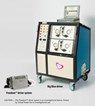
On May 3, Mayo Clinic Arizona became the first hospital in U.S. history to discharge a patient implanted with the SynCardia temporary Total Artificial Heart to wait at home for a matching donor heart. Mayo Clinic is participating in an FDA Investigational Device Exemption (IDE) clinical study of the Freedom driver, the first ever U.S. portable driver designed to power SynCardia's Total Artificial Heart both inside and outside the hospital.
Charles Okeke, 43, was implanted with the SynCardia Total Artificial Heart on Sept. 3, 2008, after his body rejected a previous donor heart transplant. For more than 600 days, Charles was confined to the hospital by the 418-lb hospital driver nicknamed "Big Blue" that powered his Total Artificial Heart.
Then, on March 26, 2010, SynCardia Systems, Inc., received conditional approval from the FDA to conduct an IDE clinical study of the Freedom portable driver in the U.S.
"When the Total Artificial Heart was implanted in 2008, I felt better than I had in years," said Charles. "Now, through the IDE clinical study, I'm able to wait at home for a donor heart with Natalie, my wife of 12 years, and our three children ages 4, 6 and 11."
Weighing only 13.5 lbs including two rechargeable, lithium-ion Onboard Batteries, the Freedom driveris designed to be carried by the patient in the Freedom Backpack or Shoulder Bag.
The IDE clinical study is approved to enroll 60 patients at up to 30 institutions. The IDE clinical study is intended to demonstrate that the Freedom driver is a suitable pneumatic driver for stable Total Artificial Heart patients and can be used safely at home.
CAUTION – The Freedom driver system is an investigational device, limited by United States law to investigational use.
About SynCardia Systems, Inc.
SynCardia Systems, Inc. is the Tucson-based manufacturer of the world's only FDA, Health Canada and CE approved Total Artificial Heart: the SynCardia temporary Total Artificial Heart. There have been more than 850 implants of the Total Artificial Heart, accounting for more than 190 patient years of life on the device.
Originally used as a permanent replacement heart, the Total Artificial Heart is currently approved as a bridge to human heart transplant for people dying from end-stage biventricular failure. The Total Artificial Heart is the only device that provides immediate, safe blood flow of up to 9.5 L/min through both ventricles.
SOURCE: SynCardia Systems, Inc.