
Automated systems tackle medication, specimen errors
By Julie Barton Miller
Healthcare writer
Contents:
Two safety nets
Testing Dx
Rx results
Specimen checks
Capturing value
A five-year study of medication errors at The Valley Hospital in Ridgewood, NJ, revealed a disturbing trend--errors at the patient's bedside. "We found approximately one-third of our errors occurred between the nurse and the patient and recognized that was our most vulnerable point," says Michael Mutter, manager of pharmacy at the 427-bed hospital.
But the bad news didn't stop with medication errors. A sharp increase in specimen errors also occurred after the hospital switched from centralized to decentralized phlebotomy collections and assigned nurses and patient care associates to collect specimens. "Most common were errors in identification," says Mutter. "Tubes were sent to the lab with no names on the labels. We had to throw the specimens away, go back to the patients and get samples again. Our redraw rate went way up, and we were looking for answers."
Two safety nets
To address these errors, two systems developed by BD (Becton, Dickinson and Company, Franklin Lakes, NJ), were installed at the hospital. The Rx and Dx systems are designed to eliminate medication errors in the administration stage and specimen errors at the collection point, respectively. Both systems combine handheld computers and bar-code technology. Besides providing safety nets at the bedside, the systems allow the hospital to track medication and specimen trends and create reports to help improve procedures.
Testing Dx
The hospital's orthopedic unit served as a test site for the Dx system. Key personnel in the unit were selected to learn about the new technology. They, in turn, conducted two-hour education sessions for other unit staff. The session went well, says Christine Lind, RN, BA, MPA, nurse manager of the orthopedic unit during system testing and performance. "There was a learning curve, of course, but we grew up with the system during its development."
Now the Dx system has been operating in 10 of the hospital's 32 units for more than a year and is scheduled to be working on the remaining units by year's end. The results, so far, have been dramatic, says Mutter, project manager for the installation. "We've had a 100 percent decrease in patient identification errors over the past year and a half."
Rx results
Although the Rx system is still in the testing stage, benefits are evident there as well. Under the system, a medication order is faxed to the pharmacy, where it is entered into the pharmacy information system. The prescription is checked to make sure the dosage is appropriate and the patient has no allergic reactions to the medicine. Medication orders flow from the pharmacy information system to a computer at the nursing station.
At the beginning of a shift, a nurse scans the bar code on her identification badge to obtain access to a computer list of all medications to be delivered to assigned patients. She checks the original handwritten order against the order in the pharmacy information system. Once the order is verified, she can administer the medication.
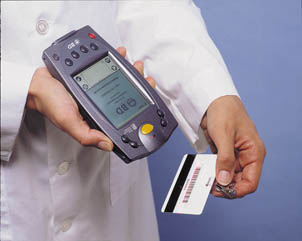
At the bedside, the nurse scans her identification badge and bar codes on the patient's identification bracelet and the drug to be administered. A scan of the patient's identification bracelet activates the patient's electronic medication administration record, viewed on the handheld computer.

The Rx system acts as a final checkpoint for verifying the "five rights." It also warns of potential allergic reactions and adverse drug interactions and documents errors. A beep and a message on the computer screen alert the nurse of errors, and she can't administer the medication until the problem is resolved.
Specimen checks
The Dx system catches errors in the collection stage by identifying the patient and the person collecting the specimen. The order for a specimen is entered into the hospital information system. The nurse or patient care associate collecting the specimen obtains access to the handheld computer by scanning her identification badge. A scan of the patient's identification bracelet brings up a list of outstanding collection orders for the patient on the computer screen. Different tests require different specimen tubes, and the tubes are color-coded to correspond with different specimen profiles.
After the specimen is drawn, a scan of a bar code on the tube links the tube with the specimen order. A portable printer, also brought to the bedside, prints the correct label for the tube. The label, applied to the tubes, connects all information to the patient.
"There's a sense of confidence that we're drawing the right specimen from the right patient and placing it in the right tube," says Lind. "The staff also finds the Dx system saves time by eliminating the hand-sorting and organizing that used to be necessary before starting phlebotomy collections."
Capturing value
Focus groups have provided opportunities for nurses to express what they value most in medication administration. "It's very personal, especially for nurses," says Mutter.
"They're told, practically from the first day of their nursing curriculum, how cautious they have to be when they give medicine. It's important that we show them the system and where the functions are. We want to capture what they value in the process. Then we have a better shot at success with the product."
Julie Barton Miller, who lives in North Stonington, CT, is a freelance writer with extensive experience covering health and medical topics.